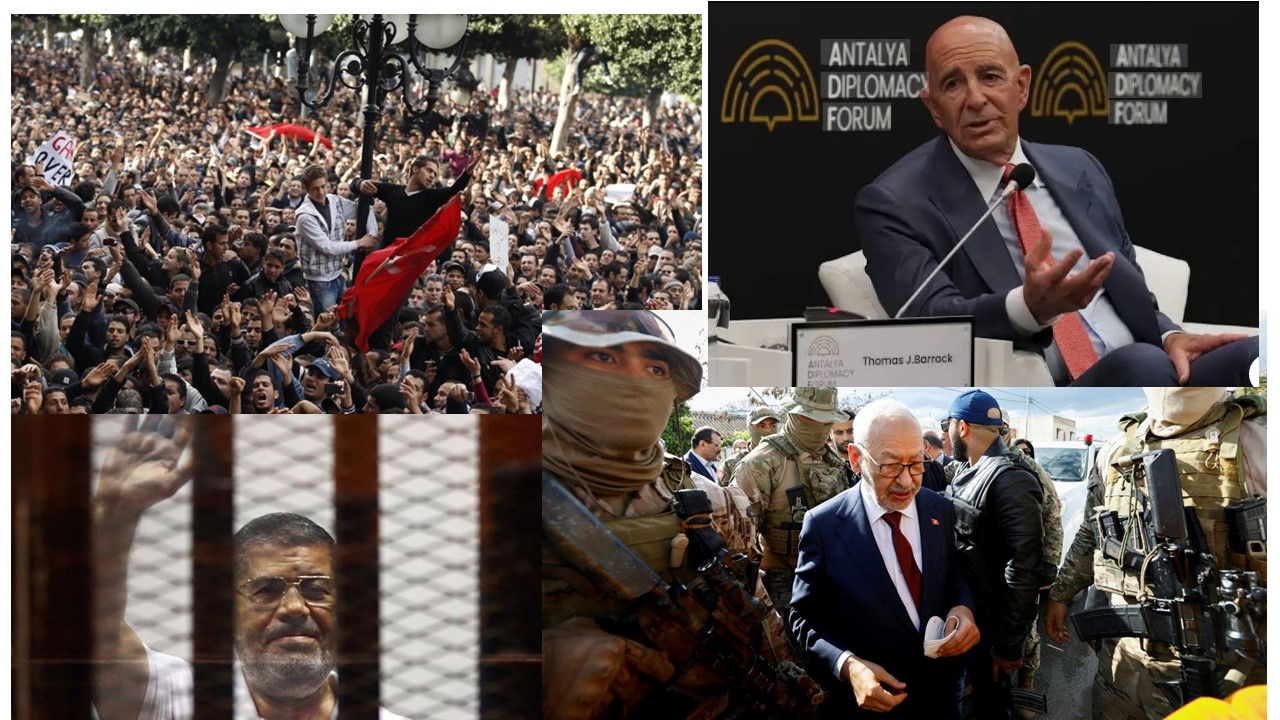
Tom Barrack’s suggestion of “benevolent monarchies or monarchical republics” for the Muslim world, while seemingly a preference for a particular regime, is in reality a stark admission of the global order of domination. This discourse is not an impartial answer to the question of why the Arab Spring “failed”; rather, it is an ideological intervention that masks how this failure was produced. Barrack’s statement that “the only thing that works is strong leadership” is not an analysis of democracy, but a political justification for why democracy is systematically obstructed.
The Struggle for Hegemony in the Egyptian and Tunisian Revolutions
The moment that emerged with the Arab Spring was not a wave of regime change in the classical sense; it was the unveiling of a hegemony crisis in the Muslim world. This crisis was not limited solely to who would hold power; The struggle involved a deeper issue: which social alliances the government would rely on, within which political form it would be institutionalized, and on what basis of legitimacy it would rest. In this context, the Muslim Brotherhood in Egypt and the Ennahda movement in Tunisia, despite all their ideological limitations, stood out as the actors within the Islamist political tradition that had the most contact with democracy. However, this did not ensure their permanence within the system; on the contrary, it made them the target of a multi-layered counter-hegemonic intervention. This is precisely where the issue lies: the inability of the actors relatively closest to democracy to maintain power cannot be explained by their “inadequacy.” The real determining factor is the hegemonic bloc organized against them. This bloc is not merely a field of political competition; it is a multi-layered order of domination established between the state apparatus, the international system, and regional power relations. The Egyptian and Tunisian experiences clearly demonstrate why revolutions cannot dismantle the state apparatus. In Egypt, the army and security bureaucracy are not only political actors but also a massive center of economic power. This structure has produced a reflexive resistance to any political transformation that threatens its existence. In Tunisia, although a “smoother” transition occurred, the cadres and bureaucratic elites of the old regime maintained their positions within the system, limiting the transformation process from within. What is common in both cases is this: no political force that came to power through elections but had the potential to transform the system was given a permanent space.
The Limits of the Islamist Movement
At this point, it is impossible to ignore the limitations of Islamist movements. The Muslim Brotherhood and Ennahda reached power but failed to establish hegemony. The main reason for this is not only external intervention, but also the limited capacity of these movements to build broad social alliances. Hegemony is not established solely by winning elections; it requires a mechanism for producing consent encompassing different classes and social segments. However, these movements failed to establish a lasting relationship of trust with secular segments, developed organic ties with the working classes, and produced a concrete alternative to the neoliberal economic structure. Their reduction of political legitimacy largely to cultural and religious representation resulted in neglecting the class basis. In Egypt, the Muhammad Morsi administration, despite operating on a fragile political ground, failed to develop an inclusive political strategy. The acceleration of constitutional processes, the narrowing of decision-making mechanisms, and the insufficient consideration of the opposition’s concerns strengthened the “authoritarianism” narrative of the opposing blocs. This provided the necessary legitimacy for the already waiting military-bureaucratic intervention. One of the main reasons for this situation, as C. Tuğal (1) points out, is that the Muslim Brotherhood movement has not acted as a political party since its inception, thus weakening the political society and preventing it from establishing a political hegemony on the basis of civil Islamization. The El Nour party was able to obtain a vote share close to that of the Muslim Brotherhood.
In Tunisia, the process unfolded in a more sophisticated manner. Although the Ennahda movement, led by Rachid Ghannouchi, followed a more conciliatory line, this approach did not translate into the construction of a strategic hegemony. The movement remained limited to the middle class and conservative base, failed to establish strong ties with the working classes, and could not draw trade union movements into its political line. Therefore, a broad “historical bloc” could not be formed, and the political landscape was reshaped in favor of secular elites and bureaucratic powers.
Inconsistencies of the Secular Segment
In this process, the attitudes of those who define themselves as secular and modernist have also been significantly decisive. These segments, which embraced the discourse of democracy, did not adhere to this principle when the election results exceeded their ideological boundaries; on the contrary, they openly or covertly supported military and bureaucratic interventions. This situation created a clear political rupture, especially in Egypt: a part of the social segments mobilized with the demand for democracy acquiesced to the coup that suspended democracy in a short time. Thus, democracy ceased to be a universal principle and was reduced to an instrumental mechanism accepted within certain class and ideological boundaries.
The real determining factor is the intervention of imperialist powers and regional hegemons!
However, it is insufficient to explain this picture only with internal dynamics. The real determining factor is the intervention of the international system and regional powers. In modern international relations, the priority of great powers is not democratic legitimacy, but governability. Due to their pluralistic and variable structures, democratic regimes can produce more unpredictable results against external interventions. In contrast, centralized and personalized regimes are more easily controlled by global powers. Therefore, Barrack’s words are not an analysis, but a clear declaration of the political form preferred by the global system. Democracy in Egypt is a nightmare, especially for Israel! Indeed, they were Sisi’s main supporters! In this context, Gulf monarchies such as Saudi Arabia and the United Arab Emirates have not only protected their own regimes but have also become active actors suppressing the possibility of democratic transformation at the regional level. It is very telling that the Salafist Al-Nour Party, supported by Gulf despots and the second-largest party in Egypt, pressured the Mubarak government, which sought compromise with secularists during constitutional debates, demanding “full Sharia law,” before later supporting Sisi’s coup.
For these regimes, the threat is not only secular-democratic movements but also Islamist movements that come to power through elections. Because this model can bring about the strengthening of popular legitimacy and the dissolution of the existing status quo. Therefore, the military coup in Egypt is not merely the result of internal dynamics; it is essentially a counter-revolution carried out with the overt or covert support of global and regional powers. In Tunisia, the same goal was achieved through more indirect means – economic pressure, political isolation, and security rhetoric.
The political situation that rulers fear most is the people somehow intervening
Barrack’s concept of a “monarchic republic” is the theoretical expression of this process. This concept describes hybrid regimes where elections formally exist, but real power is controlled by a narrow elite. This model represents a false balance between democracy and authoritarianism, which is becoming increasingly common in the modern world. In reality, this structure is a form of hegemony that suspends popular sovereignty and narrows the political space. Syria is a new example of this.
In conclusion, the experiences of Egypt and Tunisia render the debate about whether Muslim societies are “suitable” for democracy meaningless. The problem lies not in the democratic capacity of these societies, but in the systematic suppression of every political possibility approaching democracy. This repressive mechanism is operated by a de facto alliance between military-bureaucratic elites, secular tutelary circles, and institutional power centers internally, and global powers and regional monarchies externally. Therefore, the narrative that “democracy has failed” is not an analytical assessment; it is an ideological cover. The reality is far clearer: democracy did not fail in the Arab Spring; it was consciously and systematically suppressed by a multi-layered hegemonic order.
- Cihan Tuğal. The Fallof the Turkish Model. Vers 2016 ( Cihan Tuğal.Türk Modelinin Çöküşü. Agora Kitaplığı 2016


